



If you’re shopping for a home here, Mello-Roos in South Orange County is one of the first things I want you to understand. Most buyers start with the list price. But in many South OC neighborhoods, two more costs sit right behind it: a Mello-Roos special tax and HOA dues. Together they can add hundreds of dollars to your monthly payment, and every one of those dollars comes out of what a lender will let you borrow.
As both a realtor and a mortgage loan originator, I see this from both perspectives. A house located in either Ladera Ranch or Rancho Mission Viejo can be a bargain-priced property and yet more expensive monthly than an expensive property located close by. All of these points are covered in this guide – Mello-Roos explained, its differences from HOA fees, effect on mortgage loan, communities having this tax, and things to consider when making an offer.
Quick answer
Mello-Roos in South Orange County is a special tax on homes inside a Community Facilities District, mostly in newer communities like Ladera Ranch, Rancho Mission Viejo and Talega in San Clemente. It appears on your property tax bill, lenders count it in your debt-to-income ratio, and the bond portion usually ends after 25 to 40 years.
What Is Mello-Roos in South Orange County?
Mello-Roos is a special tax collected to fund infrastructure development in new communities. The Mello-Roos Community Facilities Act of 1982 created it. It was named after its two authors, Henry Mello and Mike Roos.
The following is the way it is done. A Community Facilities District (CFD) is established by a developer when developing a new community. The CFD issues bonds to pay for various items such as roads, schools, parks, sewerage, water lines, and fire station development costs upfront. The residents within the newly developed district will pay back the bond issuance cost by paying an annual special tax. Most times the district is created prior to the sale of any home within it; hence the reason most people are not aware of its existence until they want to buy one.
The majority of Mello-Roos tax in South Orange County comes from the master-planned communities established in the late 1980s. The older communities that predate the 1982 Act rarely have it.
How Mello-Roos shows up on your tax bill
You don’t pay Mello-Roos in South Orange County as a separate bill. It appears as its own line on your county property tax bill, below the base tax. The line usually names the district, such as a CFD number. Because it’s a flat line item rather than part of the tax rate, it’s easy to miss if you only compare tax rates between homes.
How the amount is set
Mello-Roos in South Orange County isn’t based on your home’s value. Each CFD has its own formula, called the rate and method of apportionment. It’s often based on square footage, lot size or the type of home. That means two homes at the same price can pay very different amounts, and a smaller home in one tract can pay more than a larger home in another.
Many districts also allow the tax to rise each year by a fixed amount, often up to 2%. Over a 30-year loan that adds up, so ask what the yearly increase is, not just this year’s number.
Does Mello-Roos ever end?
For most Mello-Roos in South Orange County, the bond portion is paid off over a set term, often 25 to 40 years from when the bonds were issued. Once the bonds are repaid, that part of the tax ends. But some districts also include a services tax for ongoing costs like park or landscape maintenance, and that part can continue with no end date.
Some districts that collect Mello-Roos in South Orange County also let owners prepay the bond portion in a lump sum. It isn’t always worth it, but it’s a question worth asking if you plan to stay a long time.
Mello-Roos vs. Regular Property Tax
In California, Proposition 13 sets your base property tax at 1% of your assessed value, which is usually your purchase price. Your assessed value can then rise by no more than 2% a year while you own the home. On top of that 1%, most bills include local voter-approved bonds, such as school or water bonds, which typically add a small fraction of a percent.
Mello-Roos in South Orange County sits on top of all of that. It’s a separate special tax that only applies to homes inside a CFD. Some homes also carry special assessments under the older Improvement Bond Act of 1915, which work in a similar way and show up on the same bill. When you compare homes, look at the total tax bill, not just the 1% base.
HOA Fees: The Other Monthly Cost
HOA dues pay your homeowners association to run the community. Depending on the neighborhood, they cover pools, clubhouses, parks, trails, landscaping, gates, security and common-area insurance. In a condo or townhome, they may also cover the roof, building exterior, water and trash. In many newer neighborhoods, these dues come on top of Mello-Roos in South Orange County, so you’ll often be paying both.
Many South OC communities have more than one association. A master association runs the large amenities, and a sub-association handles your specific neighborhood. You pay both, and some areas of Mission Viejo also have separate lake association dues.
Beyond the monthly dues, watch for three other HOA costs:
- Special assessments. If the HOA needs money for a big repair and its savings fall short, owners can be charged a one-time or temporary extra fee.
- Transfer and document fees. Buyers often pay a transfer fee to the HOA at closing.
- Reserve shortfalls. An HOA with a thin reserve fund is more likely to raise dues or charge an assessment later.
Mello-Roos and HOA Fees: Side by Side
| Mello-Roos | HOA dues | |
|---|---|---|
| What it pays for | Public infrastructure (roads, schools, utilities) | Community upkeep and amenities |
| Who charges it | A Community Facilities District | Your homeowners association |
| How you pay | On your property tax bill | Monthly or quarterly to the HOA |
| How the amount is set | District formula, often by square footage | HOA budget, voted by the board |
| Does it end? | Bond portion usually ends after a set term | Ongoing, and can rise or add special assessments |
| Where to find it | Tax bill, Notice of Special Tax, escrow tax report | Listing, HOA documents |
The key point for buyers weighing Mello-Roos in South Orange County: lenders count both. Whether a cost goes to the county or to an HOA, it’s part of your monthly housing expense.
How Mello-Roos in South Orange County Affects Your Mortgage Approval
When a lender decides how much you can borrow, they look at your debt-to-income ratio (DTI). That’s your monthly debts plus your new housing payment, divided by your gross monthly income. Most loan programs cap DTI somewhere around 43% to 50%, depending on the program and your full file.
Your housing payment isn’t just principal and interest. It includes property taxes, homeowners insurance, HOA dues and, for many homes, Mello-Roos in South Orange County. Every dollar of fees is a dollar that can’t go toward the loan itself.
Here’s a simple example. Say you’re approved for a total housing payment of $7,000 a month, and you’re comparing two homes listed at the same price:
| Home A | Home B | |
|---|---|---|
| HOA dues per month | $150 | $350 |
| Mello-Roos per month | $0 | $400 |
| Total fees per month | $150 | $750 |
| Left for the loan payment (vs. Home A) | Baseline | $600 less |
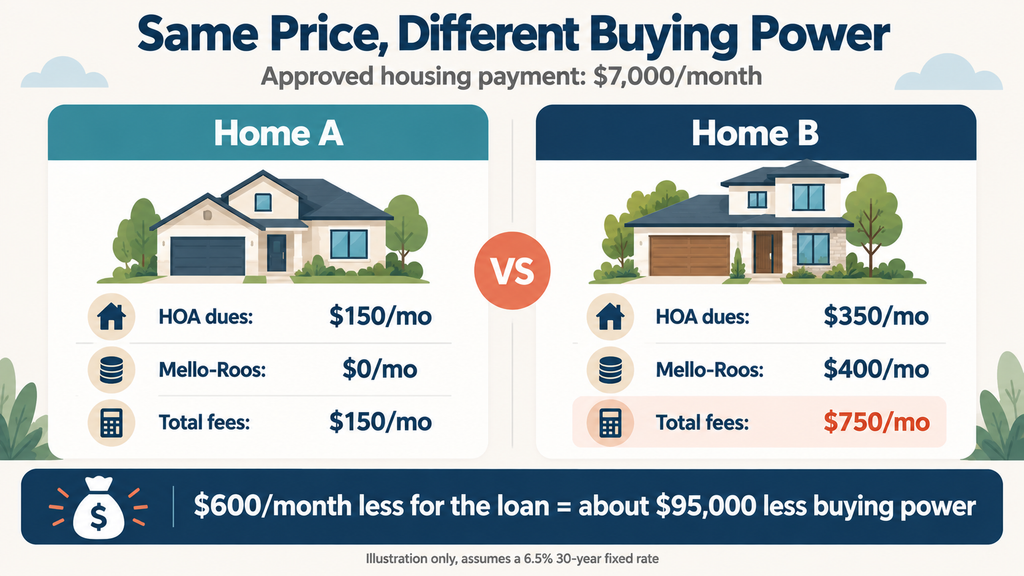
At an assumed 6.5% 30-year fixed rate, $600 a month supports about $95,000 of mortgage. So Home B could cost you roughly $95,000 in buying power, even though both homes have the same price tag.
This example is for illustration only. Your rate, taxes, and loan program will change the numbers. For new construction, the lender may use the district’s estimated tax until the first full bill comes out, so get that estimate in writing early.
Which Communities Have Mello-Roos in South Orange County?
The rule of thumb: the newer the community, the more likely it is to have Mello-Roos in South Orange County. Here’s how it generally plays out:
- Ladera Ranch. Built with CFD financing. Most homes carry both Mello-Roos and HOA dues, often with more than one association.
- Rancho Mission Viejo. The newest large community in the area, including Sendero, Esencia and Rienda. Expect Mello-Roos and HOA dues on most homes.
- San Clemente. Newer areas such as Talega commonly have Mello-Roos. Many older neighborhoods closer to the coast do not.
- Mission Viejo. Much of the city was built before 1982 and generally doesn’t have Mello-Roos, but most neighborhoods have HOAs, and some have lake association dues.
- Dana Point and Laguna Niguel. Many neighborhoods have no Mello-Roos. Gated and resort-style communities usually have higher HOA dues for security and amenities.
- San Juan Capistrano. A mix. Some older areas have no HOA at all, while newer tracts may have both.
Mello-Roos in South Orange County are set by district boundaries, so two homes a few streets apart can be different. Always check the specific address. If you’re comparing neighborhoods, my latest South Orange County market update can help you compare prices too.
How to Find Out If a Home Has Mello-Roos
You don’t have to guess whether a home has Mello-Roos in South Orange County. There are four reliable ways to check:
- Look up the property tax bill. The Orange County Treasurer-Tax Collector lets you view past bills by address or parcel number. A special tax or CFD line is your Mello-Roos.
- Ask for the Notice of Special Tax. California requires sellers to make a good-faith effort to give buyers this notice. Ask for it before you make an offer, not after.
- Read the tax report in escrow. The natural hazard disclosure package ordered in escrow often includes a report listing any special taxes and assessments on the property.
- Check district records. The California Debt and Investment Advisory Commission publishes information on Mello-Roos districts statewide.
Buying New Construction With Mello-Roos in South Orange County
New homes are where buyers meet Mello-Roos in South Orange County most often, especially in Rancho Mission Viejo. Builder sales offices are usually upfront about it, but the details matter, and the numbers you see in a brochure aren’t always what you’ll pay.
Before you sign a purchase contract with a builder, ask for these in writing:
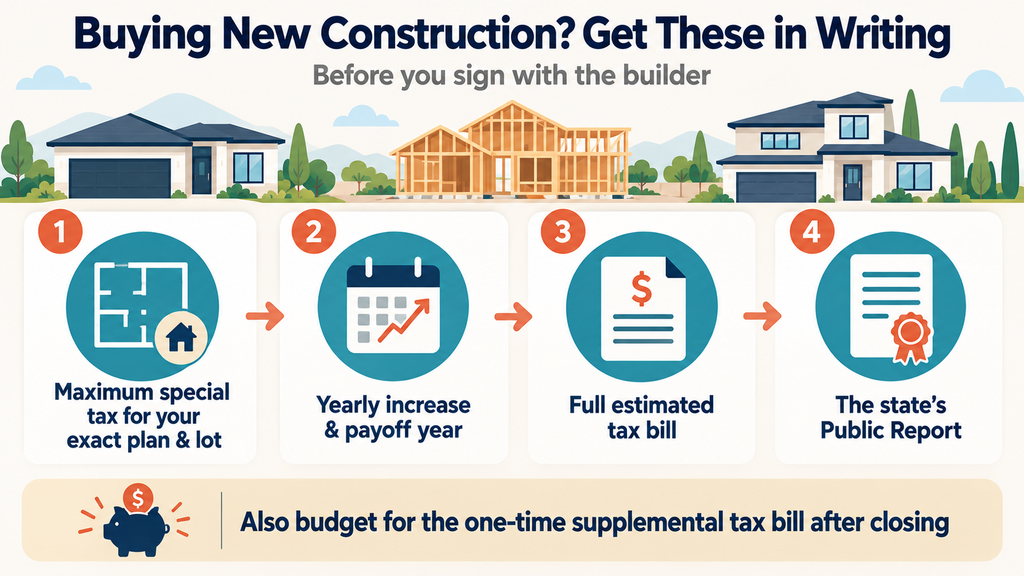
- The maximum special tax for the exact plan and lot. Because the formula is often based on square footage, a larger floor plan in the same community can carry a noticeably higher tax.
- The yearly increase and the payoff year. These tell you what the tax will look like five or ten years from now.
- The full estimated tax bill. Ask for the base tax, local bonds, Mello-Roos and any assessments added together, so you can compare it with resale homes.
- The state’s Public Report for the project. New subdivisions in California come with a Public Report from the California Department of Real Estate, which describes special taxes and assessments.
Also plan for a supplemental tax bill. After any purchase in California, the county reassesses the home and sends a one-time supplemental bill for the difference between the old and new assessed value. It isn’t Mello-Roos, but it often arrives in the first year and catches new owners off guard. Set money aside for it, and ask your lender to estimate it before closing.
If you’re comparing a new build with a resale home nearby, I’ll line up the total monthly cost of both side by side. That’s usually where the real difference between them shows up.
Is a Home With Mello-Roos a Bad Deal?
Not at all. Much of the Mello-Roos in South Orange County paid for the schools, parks, roads and utilities that make many South OC communities so desirable. Homes in these areas are often newer, with modern layouts and energy-efficient systems, and the neighborhoods tend to be well planned.
The real question is total cost. A home with Mello-Roos and a lower price can cost the same each month as a home without it at a higher price. That’s why, when clients ask me about Mello-Roos in South Orange County, I compare homes by full monthly payment, not list price. Also think about resale: when you sell, your buyer’s lender will count the same Mello-Roos against them, so a tax that ends soon can make your home easier to sell.
7 Things to Check Before You Make an Offer
Here’s the checklist I use for any home with Mello-Roos in South Orange County:
- Pull the tax bill and note the exact Mello-Roos amount.
- Ask when the bonds pay off and whether any services tax continues after that.
- Ask about the yearly increase allowed by the district.
- Get every HOA fee in writing, including master, sub-association and lake dues, plus transfer fees.
- Review the HOA documents for the budget, reserves and any planned special assessments. California law requires sellers to provide these.
- Run the full monthly payment with taxes, insurance, HOA and Mello-Roos for that exact home.
- Think about resale, including how many years of Mello-Roos the next buyer will take on.
Frequently Asked Questions
Is there an effect of Mello-Roos in South Orange County on how much I am able to borrow?
Yes, and to a greater extent than many homebuyers anticipate. When calculating the debt-to-income ratio, mortgage lenders factor in Mello-Roos fees in addition to the usual payments on housing, insurance, property tax, and any HOA fees as part of the monthly cost of housing.
Are Ladera Ranch homes for sale generally subject to Mello-Roos?
They usually are. Being built using CFD financing, the vast majority of homes in Ladera Ranch will come with Mello-Roos in addition to HOA fees, which may be collected by more than one homeowners’ association. It may vary from tract to tract, but one needs to inquire about Mello-Roos on the specific property.
How much are Ladera Ranch HOA fees?
It depends on the neighborhood. Many homes in Ladera Ranch pay into a master association plus a sub-association for their specific tract, so you could have two HOA dues to budget for. Ask for every fee in writing, including transfer fees, and look at the HOA’s reserves before you commit.
Do Rancho Mission Viejo new homes come with Mello-Roos?
Most do, including homes in Sendero, Esencia, and Rienda. If you’re buying from the builder, ask for the maximum special tax for your exact plan and lot, the yearly increase, the payoff year, and the state’s Public Report. And set money aside for the supplemental tax bill that usually shows up in the first year.
Is Mello-Roos tax California-wide or just in Orange County?
It’s a state law. The Mello-Roos Community Facilities Act of 1982 applies across California, so you’ll find these districts in newer communities all over the state. South Orange County just has a lot of them because so many master-planned communities were built here after 1982.
Do Mello-Roos ever go away?
The bond part usually does, often 25 to 40 years after the bonds were issued. But some districts also have a services tax for things like park and landscape maintenance, and that part can keep going with no end date. Always ask which one you’re looking at.
The Bottom Line
Price Mello-Roos in South Orange County into every comparison, the same way you’d price in HOA dues or insurance. Once you know the full monthly cost of each home, you can compare them fairly and make an offer with confidence. Knowing these numbers early also gives you real leverage when it’s time to negotiate price or credits with the seller.
That’s the advantage of working with one person who handles both the purchase and the loan. I can look at a home, check for Mello-Roos in South Orange County, and tell you right away what it does to your monthly payment and your approval amount. No waiting on a separate lender, and no surprises halfway through escrow.
Thinking about buying in Mission Viejo, Ladera Ranch, Rancho Mission Viejo, San Clemente, Dana Point or anywhere in South Orange County? Visit the Get a Loan page or contact me, and I’ll run the real numbers on the homes you’re considering.