



Someone added the patio enclosure in 1994. Or the previous owner turned half the garage into a bedroom without pulling a permit. Now that you’re about to put the house on the market, you’re wondering if this room will sink the deal. Here’s my straight answer: selling a house with unpermitted work is common in Orange County, and most of these deals close. The ones that fall through usually fail for the same reason: the seller learns about the issue at the same moment the buyer does.
I see this from three chairs. I’m a licensed California real estate broker and mortgage loan originator, and before that I was a city planner with a master’s degree in Urban and Regional Planning from UC Irvine. So when a client mentions a room addition with no permits, I’m weighing the disclosure form, the appraisal and the permit counter all at once. That’s what this guide to selling a house with unpermitted work covers.
Why Selling a House With Unpermitted Work Isn’t Automatically a Deal-Killer
Unpermitted work is far more common than the average seller imagines.
The best data I’ve found is a 2024 paper in the Journal of the American Planning Association, which identified detached ADUs in San Jose from satellite images. According to that analysis, 1,336 detached ADUs were built in San Jose between 2016 and 2020, and only 291 of them were matched to permits. That means 78.2 percent were built without a permit, or about three or four informal units for every legal one.
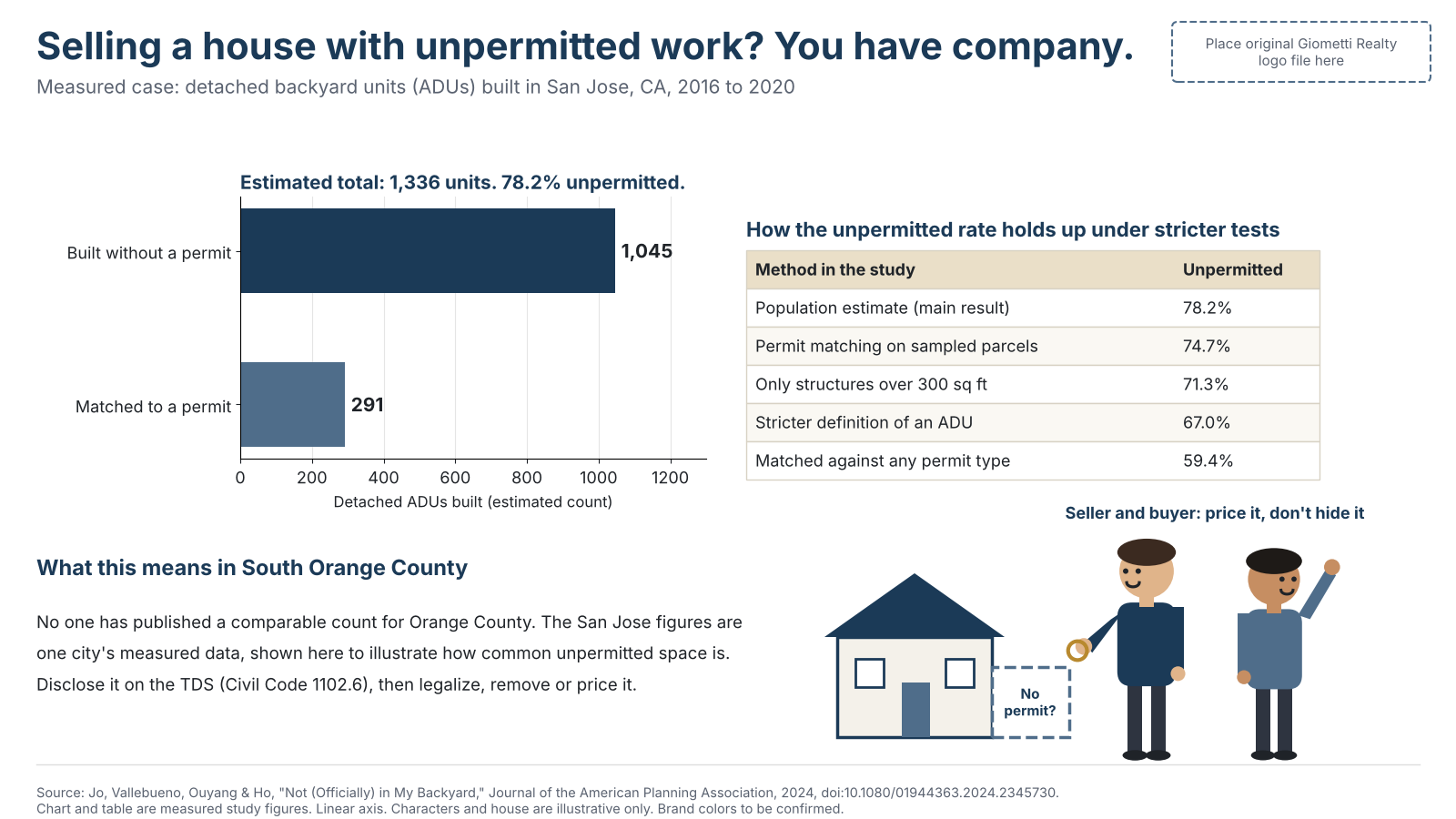
San Jose is not Mission Viejo. There’s no comparable study for Orange County, and I’m not going to claim otherwise. But the findings match what every agent in South County sees firsthand: unpermitted additions are everywhere. And what scares buyers is the uncertainty.
So your goal isn’t to make the problem disappear. It’s to trade uncertainty for facts a buyer can put a dollar value on. Do that, and selling a house with unpermitted work becomes just another negotiation.
Disclosure Comes First, and It Isn’t Optional
California’s Real Estate Transfer Disclosure Statement in Civil Code section 1102.6 asks directly whether there are room additions, structural modifications, or other alterations or repairs made without the necessary permits. It’s a yes-or-no box. There’s no “kind of.”
Owners selling a house with unpermitted work often ask whether they can leave that box blank because the work was done before they owned the home. You can’t. The question is about what you know, not who did the work. If the inspection report from your own purchase flagged that converted garage, you know.
It’s spelled out in the law. Under Civil Code section 1102.13 on failure to disclose, anyone who willfully or negligently fails to make a required disclosure is liable for the buyer’s actual damages. That doesn’t cancel the sale, but the bill can still be large.
There’s one more disclosure rule, and it targets flips. If you accept an offer within 18 months of taking title, Civil Code section 1102.6h’s added disclosure rule for resales requires extra disclosures about the improvements you made, including permit information. It applies to offers accepted on or after July 1, 2024.
Timing matters too. When disclosures reach a buyer after they’ve signed an offer, Civil Code section 1102.3’s cancellation window gives them three days after personal delivery, or five days after mailing, to back out. Deliver the forms late and you’ve handed the buyer a fresh exit. When you’re selling a house with unpermitted work, give them everything up front.
What Happens If an Inspector Finds Unpermitted Work
Let’s say you didn’t know. The buyer’s inspector walks into the family room, notices the floor drops an inch, sees mismatched stucco outside, and writes it up. What now?
First, the inspector doesn’t represent the city. A home inspector works for the buyer and documents conditions. They don’t issue citations, and the report doesn’t go to code enforcement. So what happens if an inspector finds unpermitted work is mostly a negotiation, not a legal event.
Second, the buyer’s agent will ask for the property’s permit history. You can usually get it from your city’s building department, and anyone selling a house with unpermitted work should pull it before listing, not after. If the records show nothing for a 300-square-foot addition, expect the buyer to ask for a credit, a lower price, or permits finished before closing.
Third, and this is the part sellers overlook, the appraiser is about to weigh in. That’s where financing comes into play.
How Unpermitted Square Footage Hits the Appraisal and the Loan
This is my lender hat. The Fannie Mae Selling Guide’s appraisal standard for additions without permits, section B4-1.3-05, tells appraisers that when they find an addition without a required permit, they have to comment on the quality and appearance of the work and its effect, if any, on market value. That’s the rule. It doesn’t mean the loan goes away.
In practice, it comes down to the quality of the work and whether nearby sales include similar additions. A nicely finished family room with matching finishes could carry real value. A garage conversion with a window AC unit and a space heater running off an extension cord? Probably not.
A separate living unit gets a stricter rule. If the home has an ADU that zoning doesn’t allow under any circumstance, the loan can still qualify, but only when the appraisal shows at least two comparable sales with the same noncompliant use and the lender confirms it won’t jeopardize a future insurance claim. That’s a narrow path. Before we list, I want to know how a lender will read that space.
If you’re selling a house with unpermitted work and that room is a big part of your asking price, the appraisal is where any gap will show up. Plan for it. Get an honest home value estimate for your South Orange County property that looks at the space both ways, counted and not counted, so you see the range early.
Selling a House With Unpermitted Work: Fix It, Disclose It, or Price It
There’s no single right answer. There are three options, and the right one depends on the quality of the work, your timeline and your budget.
Legalize before you list. You apply for an as-built permit, open up walls where the inspector needs to see framing, wiring or plumbing, and fix anything that doesn’t meet code. It’s the slowest and most expensive option up front. It also gives you the cleanest sale, and the square footage can count.
Disclose and sell as-is. You check the box, attach the information you have, and price the house so the buyer takes on the risk. This is usually the fastest route. It works best when the work was done well and the room isn’t central to the home’s value.
Take it out. Sometimes the best move is to remove the unpermitted kitchenette from the garage and get the parking back. It’s less dramatic than it sounds.
Which one I’d recommend depends on the house in front of me. That’s why my selling process starts with a pre-inspection walkthrough, and why I’d rather find the problem in your living room than in a buyer’s report. My page on how to prepare your home to sell covers that first step.
AB 2533 Changed the Math for Older ADUs and Garage Conversions
Here’s what I wish more South County sellers knew. Since January 1, 2025, Government Code section 66311.7, the ADU amnesty law created by AB 2533, has given owners real protection when they legalize an ADU or junior ADU built before January 1, 2020.
What kind of protection? A city generally can’t deny the permit just because the unit doesn’t meet current building standards or local ADU rules. The exception is anything that creates a health and safety problem, which the owner still has to fix. The owner can’t be charged impact fees or connection and capacity fees unless utility work is needed for health and safety. And the city can’t penalize the owner for building without a permit in the first place. The state’s ADU Handbook from the California Department of Housing and Community Development explains how this fits with the rest of ADU law.
If you’re selling a house with unpermitted work, such as a 2015 garage conversion, this is a big deal.
It changes “this can’t be fixed” to “this can likely be fixed, and the city has to work with us.” According to the City of Mission Viejo’s ADU reference guide, ADUs and JADUs get ministerial review through building permit plan check. If you live in Mission Viejo, this is where you start.
Does it apply to a room addition that isn’t an ADU or JADU? No. AB 2533 covers ADUs and JADUs only. A simple bedroom extension goes through the usual permit process.
When a Seller Didn’t Disclose Unpermitted Work
Now reverse it. Say you bought your home a few years ago and just found out the sunroom was never permitted. Before you sell, you’re typing “can I sue previous owner for unpermitted work” into a search bar late at night.
Possibly. I’m not a lawyer, so check with one about your particular facts. But the structure is no mystery. If the seller didn’t disclose unpermitted work they knew about, you may have a claim under section 1102.13, and possibly for fraud. Deadlines apply. Under Code of Civil Procedure section 338(d) on fraud claims, a fraud claim generally has three years, and the clock doesn’t start until the buyer discovers the facts. A claim on a written contract has four years under Code of Civil Procedure section 337.
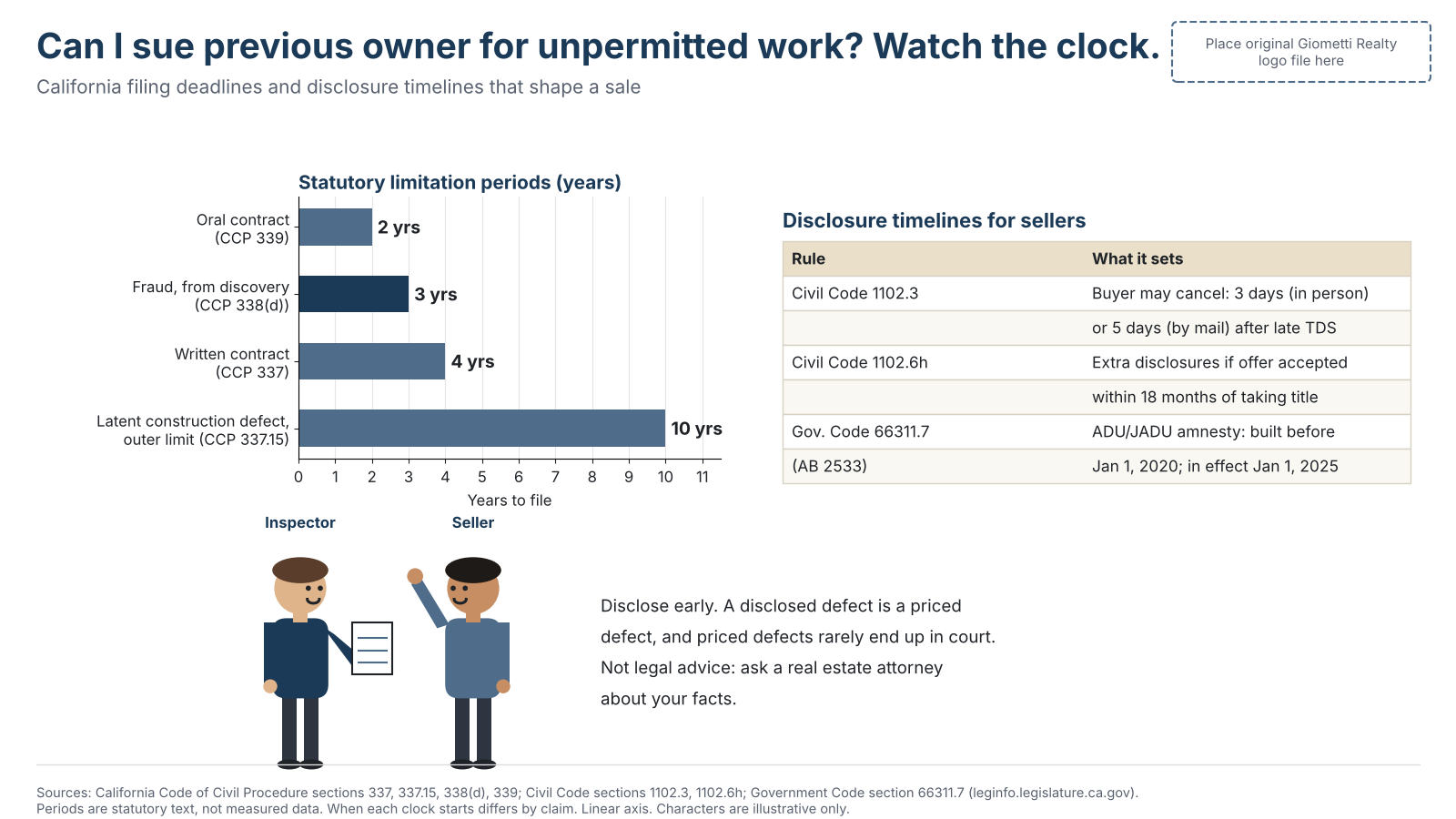
Why does this matter if you’re selling a house with unpermitted work you only just discovered? You can’t pass the problem along. Whatever you know, you have to disclose, even if someone else hid it from you. The good news: a disclosed defect is a priced defect, and priced defects rarely come back as lawsuits.
What Buyers Are Weighing on the Other Side of the Table
Buyers search “buying house with unpermitted work” for a reason. They worry about three things. Will they end up paying to legalize it? Will their lender and insurer treat the space as real? And will they inherit the same disclosure headache when they sell?
When you’re selling a house with unpermitted work, you can answer all three before anyone asks. Pull the permit history. Have a contractor or the city scope what it would take to legalize the work. Find out how the space is likely to appraise. Because I’m the broker and lender in one for many South Orange County buyers, I can handle the financing question without waiting on a third party. Buyers who start with mortgage prequalification find out early whether a property with unpermitted space works for their loan.
A buyer handed a folder with permit records, a scope estimate and a clear disclosure acts very differently from one who discovers the problem on day nine of escrow. One negotiates. The other panics, and panicked buyers cancel. It’s the same logic as knowing about Mello-Roos in South Orange County before an offer goes in: surprises cost more than facts.
A Planner’s Checklist Before You List
Here’s what I’d want done before selling a house with unpermitted work goes live on the MLS:
- Pull your permit history from the city’s building department and compare it with the square footage the county assessor has on file.
- Walk the house with someone who knows the signs: floors that step down, mismatched windows, a newer electrical panel with no final sign-off.
- Decide whether the space is an ADU or JADU that may qualify for AB 2533 relief, or an ordinary addition.
- Get a rough scope and cost for legalizing it from a licensed contractor.
- Fill out the disclosure honestly and attach what you’ve gathered.
- Price the home both ways, with and without the space counted, so you know your floor.
Planners notice the details that don’t match the record. I spent years on the government side of that counter, and you can read more about my planning and lending background. If you’re still deciding whether now is the time, my guide to deciding to sell your home is a good place to start. Once you’re in escrow, here’s how inspections and appraisals work during a sale. And if you need local help along the way, my preferred vendors page lists businesses I refer clients to.
Selling a house with unpermitted work isn’t a scandal. It’s a project. Handle it like one and it will usually close.
Frequently Asked Questions
Can you sell a house with unpermitted work in California?
Yes. California doesn’t prohibit selling a house with unpermitted work. It requires you to disclose what you know on the Transfer Disclosure Statement. Most sellers legalize the work, remove it or price it in, and the sale closes normally.
Do I have to disclose unpermitted work if the previous owner did it?
Yes. Selling a house with unpermitted work you didn’t build still means disclosing it. The form asks what you know, not who built it. If you know an addition or conversion lacks permits, you have to say so, even if it was done before you owned the home.
What happens if an inspector finds unpermitted work during escrow?
The inspector is hired by the buyer and doesn’t report to the city. The finding usually leads to a negotiation: a credit, a lower price, or permits completed before closing. The appraiser may also limit the value given to that space.
Can a buyer get a mortgage on a house with unpermitted additions?
Often, yes. Fannie Mae asks the appraiser to evaluate the quality of the work and its effect on value, rather than banning the loan. The result depends on the quality of the work and on comparable sales nearby.
Does AB 2533 help with an unpermitted garage conversion?
It can, if the conversion is an ADU or junior ADU built before January 1, 2020. The law limits fees and penalties and stops cities from denying the permit over most code gaps, though health and safety problems still have to be fixed.
Can I sue previous owner for unpermitted work they didn’t disclose?
You may have a case if the seller knew and didn’t disclose it. Fraud claims in California generally have to be filed within three years of discovery. Talk to a real estate attorney about your specific situation before you list.
Talk It Through Before You List
If you’re thinking about selling a house with unpermitted work anywhere in South Orange County, call or text me at (949) 422-5750. I’ll look at the work with a planner’s eye, check the financing side as a lender, and tell you straight which option fits.